The Skills That Matter Most
最重要的能力
The skills that matter most — reasoning from first principles, identifying the right problems, iterating through complexity — have always been valuable. We teach them rigorously through mathematics and engineering, building the mastery that produces true excellence.
Mandarin at Binjai is a living tool for technical discovery. We bridge the gap between classroom vocabulary and real-world application — transforming 'learning a language' into 'using a language' to solve complex problems.
Our approach draws from IB inquiry principles — students as active researchers, not passive recipients. Through mentor-led projects, children develop the Learner Profile attributes: becoming risk-takers who attempt challenging problems, communicators who explain thinking in two languages, and reflective learners who understand their own growth.
Curiosity First
激发好奇心
We nurture 'why?' instead of 'memorize this.' Children who ask good questions become adults who formulate problems clearly.
Learning Through Doing
动手学习
Experience gravity by rolling balls down ramps they built. Understand sequences by giving instructions. Hands-on learning builds lasting intuition.
Comfort With Iteration
拥抱迭代
When something doesn't work: 'What could we adjust?' This builds the problem-solving mindset that defines effectiveness with AI.
Joy in Making Things Work
创造的喜悦
The satisfaction when their arcade game finally works builds identity: 'I'm someone who figures things out.'
Mastery Produces Excellence
真正的卓越源于精深的掌握
Strong portfolios, academic results, and competition success flow naturally from genuine capability - not from optimizing for these outcomes directly. We focus on building the underlying mastery: clear thinking, methodical tinkering, and precise communication in two languages.
Children who think precisely and communicate clearly become capable adults. We develop these foundational capacities through rigorous mathematics and hands-on engineering challenges conducted bilingually.
Start early, and these become natural:
- Problem-solving confidence through appropriate challenge
- Bilingual technical fluency through meaningful use
- Resilience through productive iteration
- Identity as capable builders and thinkers
"By age 11-12, many children have decided 'I'm not good at math' or 'I give up when things are difficult.' These beliefs are hard to shift. The foundation years are when we cultivate the mindsets that matter."
Three Pillars of Excellence
卓越教育的三大支柱
We build the deeper capabilities that produce excellence naturally. Children who think precisely and communicate clearly become capable adults — and that mastery produces the strongest outcomes.
Deep Problem-Solving
深度解题能力
Rigorous mathematical reasoning through competition math curriculum. First principles understanding, iterative problem-solving, systems thinking.
- Problem decomposition and pattern recognition
- Iterative refinement - test, observe, improve
- First principles thinking - understand WHY, not just HOW
- Clear communication and precise articulation
Bilingual Capability
双语能力
Vocabulary isn't memorized in isolation — it's acquired through building, testing, and debugging. Students don't just know the word, they understand the logic behind it.
- Not word lists: vocabulary through hands-on context
- Technical terms (齿轮, 杠杆, 滑轮) learned through building
- Mandarin as the medium, not just the subject
- True cognitive bilingualism through meaningful use
Mentorship by Excellence
精英导师制
NUS/NTU STEM graduates as role models. Socratic method - asking 'what do you think will happen?' rather than giving answers.
- Small groups (1:8) for individual attention
- High-achieving mentors, not just tutors
- Competition pathway (SMKC, SASMO, NMOS)
- Expect excellence, not 'good enough'
Deeper Skills, Better Outcomes
深层技能,卓越成果
The foundational skills overlap deeply — problem decomposition, pattern recognition, logical reasoning, clear communication, and persistence drive both competition medals and long-term capability.
What This Leads To:
- PSLE success and High Ability Learner identification
- Math competition medals (SMKC, SASMO, NMOS)
- Secondary school readiness (IP, IB programs)
- Chinese language proficiency through contextual use
- Knowing what problems are worth solving
- Translating vague ideas into clear instructions
Founded by Parents Who Couldn't Find What They Were Looking For
由找不到理想教育的父母创办
A Columbia engineer and UT-Austin curriculum specialist built Binjai Academy for their own daughters first — now sharing it with families who share their vision.
Read Our StoryLearning in Action
真实课堂场景
Our classrooms are alive with building, experimenting, and discovery — where children learn by doing, not just listening.
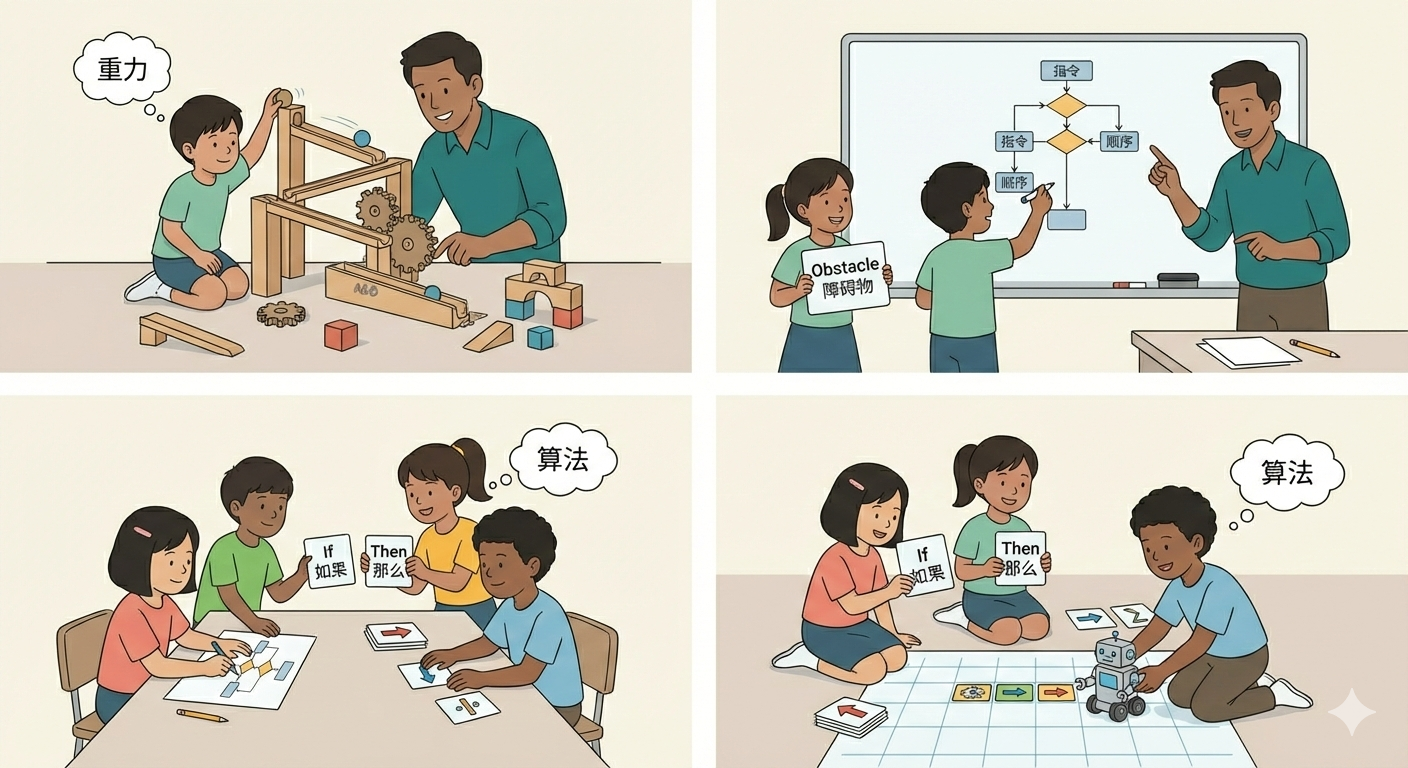
Engineering with Gravity
重力原理探索
Building catapults and learning physics through hands-on projects
Bilingual Flowcharts
双语流程图
Learning algorithmic thinking with bilingual instruction
Algorithm Games
算法游戏
Computational thinking through card-based logic puzzles
Robot Building
机器人制作
Building and testing mechanical systems together
Our Programs
我们的课程
Two flagship programs designed to develop deep problem-solving capability through mathematical reasoning and hands-on engineering.